Glossary · Page Layout
Explore →Bottom-of-Page Footnotes: Book Publishing Guide | ArteBook
What Bottom-of-Page Footnotes means in book publishing and KDP: key formatting specs, pitfalls, and how ArteBook Studio automates it.
Clear publishing definition, technical specifications, real-world examples, and automated workflow guide for Sequential Figure & Table Captions.
| Specification Dimension | Sequential Figure & Table Captions Standard | ArteBook Studio Implementation |
|---|---|---|
| Publishing Domain | Page Layout, Margins & Book Typography | Built natively into the collaborative book editor & export suite. |
| Technical Benchmark | Fine Editorial Typesetting & Multi-Device Accessibility Rules | Validated automatically prior to KDP, Apple Books, or journal upload. |
| Primary Failure Mode | Risk of using uniform narrow margins or cramped line spacing that swallows inner text into the glued paperback spine | Eliminated via semantic chapter templates and live pre-publish checks. |
| Supported Export Targets | Print PDF (6×9, 5.5×8.5, A5, A4), EPUB 3.0, DOCX, JATS XML | Generated from one single-source manuscript in one click. |
| Plan Availability | Included from $0 Starter Studio & $14.99/mo Creator | 100% commercial rights + upfront credit estimates on AI actions. |
In professional book production, sequential figure & table captions directly shapes both storefront approval and reader trust. Because Sequential Figure & Table Captions is consistent numbered labels (such as Figure 3.2 or Table 4.1) paired with concise explanatory captions so text cross-references remain unambiguous across print and reflowable layouts, getting it right separates bookstore-caliber trade paperbacks, Kindle editions, and cited monographs from amateur document uploads.
First-time authors and busy marketing or academic teams most frequently run into trouble by using uniform narrow margins or cramped line spacing that swallows inner text into the glued paperback spine. Addressing sequential figure & table captions systematically inside your manuscript architecture protects your reviews, improves Look Inside sample conversion, and saves hours of last-minute reformatting.
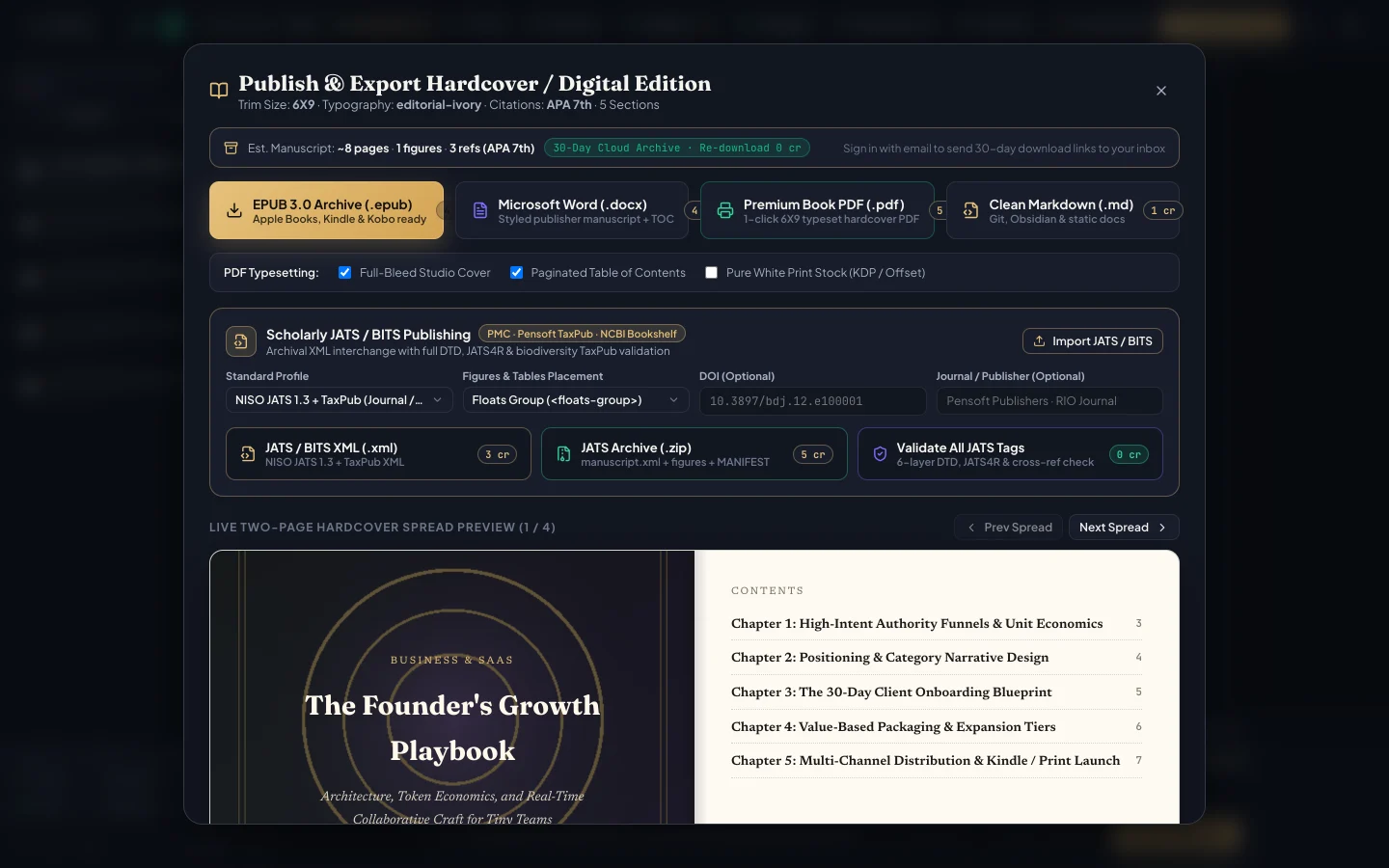
Whether you are producing a 35-page B2B lead magnet, an interactive A4 client workbook, a 180-page 6×9 Amazon KDP trade paperback, or a peer-reviewed scientific manuscript, align sequential figure & table captions with Fine Editorial Typesetting & Multi-Device Accessibility Rules. Pair clear H1–H3 chapter hierarchy with scannable comparison tables, callouts, numbered figures, mathematical equations, or verified DOI citations (APA, MLA, Chicago, Harvard, IEEE, Vancouver) wherever readers need concrete evidence.
During developmental and copyediting passes, invite your co-author, ghostwriter, or editor to inspect sequential figure & table captions in real time using Track Changes, inline comments, book-wide Find & Replace, and warm Editorial Ivory paper reading mode—catching visual or structural inconsistencies long before launch day.
ArteBook Studio eliminates manual layout guesswork because the platform applies mirrored gutter margins, running headers, widow/orphan control, and dual Obsidian/Paper proofing themes automatically. From your Author Dashboard, you can start from an Idea-to-Book blueprint, import an existing Microsoft Word (.docx) or XML manuscript, dictate chapters by voice across 59 languages, or attach research PDFs and notes with upfront AI credit estimates displayed before every click.
When your team signs off, export Print-Ready PDF (6×9, 5.5×8.5, A5, or A4 with mirrored margins, running headers, linked table of contents, and bleed), Reflowable EPUB 3.0, editable Word (.docx), and Validated JATS XML—complete with 30-day cloud download links emailed automatically and 100% royalty retention ($0 Starter Studio; $14.99/mo Creator with 600 credits).
Sequential Figure & Table Captions is consistent numbered labels (such as Figure 3.2 or Table 4.1) paired with concise explanatory captions so text cross-references remain unambiguous across print and reflowable layouts.
The biggest pitfall is using uniform narrow margins or cramped line spacing that swallows inner text into the glued paperback spine. Using a dedicated book studio prevents manual conversion defects across print and digital editions.
Yes. ArteBook Studio applies mirrored gutter margins, running headers, widow/orphan control, and dual Obsidian/Paper proofing themes automatically—starting at $0 on Starter Studio and $14.99/mo on Creator (600 credits) with 100% author royalties.
What Bottom-of-Page Footnotes means in book publishing and KDP: key formatting specs, pitfalls, and how ArteBook Studio automates it.
What Chapter or Book Endnotes means in book publishing and KDP: key formatting specs, pitfalls, and how ArteBook Studio automates it.
What Book Table Typography means in book publishing and KDP: key formatting specs, pitfalls, and how ArteBook Studio automates it.
What Cream vs White Interior Paper means in book publishing and KDP: key formatting specs, pitfalls, and how ArteBook Studio automates it.
What Clean Chapter Page Breaks means in book publishing and KDP: key formatting specs, pitfalls, and how ArteBook Studio automates it.
What Back-of-Book Subject Index means in book publishing and KDP: key formatting specs, pitfalls, and how ArteBook Studio automates it.
Plan the exact order of front matter and back matter pages for your Amazon KDP paperback, Kindle eBook, academic monograph, or lead magnet.
Build a Project Mgmt & Agile illustrated guide (48–96 pages) in ArteBook Studio with live co-authoring, voice dictation, and KDP/EPUB exports.